Regular music frequency area
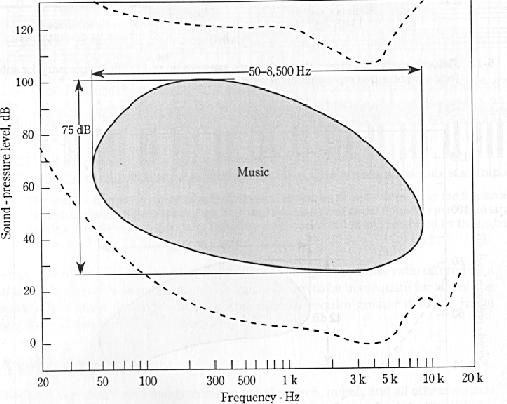
That’s only the rough estimate from a textbooks. It is not the ultimate guide therefore do not embrass it, but show it anyway.
Please carry a RTA and measure a kick drum, wonder why it’s nearly up to 20kHz? Still strong at 8kHz and yet it’s suppose to be bass only?
Carry the RTA and set to peak for easier capturing and viewing. Measure other instrument, noises, etc.
Measure it near, real near. Measure it far too. Do everything one can think of and think about the results. Don’t forget, sound is wave and wave is in “Time” domain.
The chart above shows frequncy domain, if that was to be represented in time domain, then it would simply look like extremely dense complex waveform.
In actual fact, the chart above, technically, cannot be represented by time domain, cause the chart above contains both low level and loud levels.
In time domain, it can only show either low of high at any one time, unless, one overlaps two wave using different colors.
Most people would have seen sound in some software, where it shoots up and down and moves along from left to right and one can time index from low value to high value. i.e. time moving.
It is an extremely complicated display, which human brains are in-capable of understanding, therefore frequency domain was created.
- The Human Ears
- Disclaimer
- Questions
- How is sound created?
- How do sound travel?
- How loud is loud?
- How does the ear work?
- How does the ear work 2?
- Hairlike Nerve Died
- How to localize sound?
- What do we listen for - to?
- How do we listen?
- How to differentiate level?
- What sound can be heard or not?
- Regular music frequencies area
- Questions and Answers
- Example of sound in Frequency Domain
- Example of sound in Time Domain
- One prove of human listening in Time Domain
- Conclusion
- A New Thought
- Side notes